WordPress SEO Service: Why 90% of Austin's Tech Brands Are Failing Pagespeed Insights


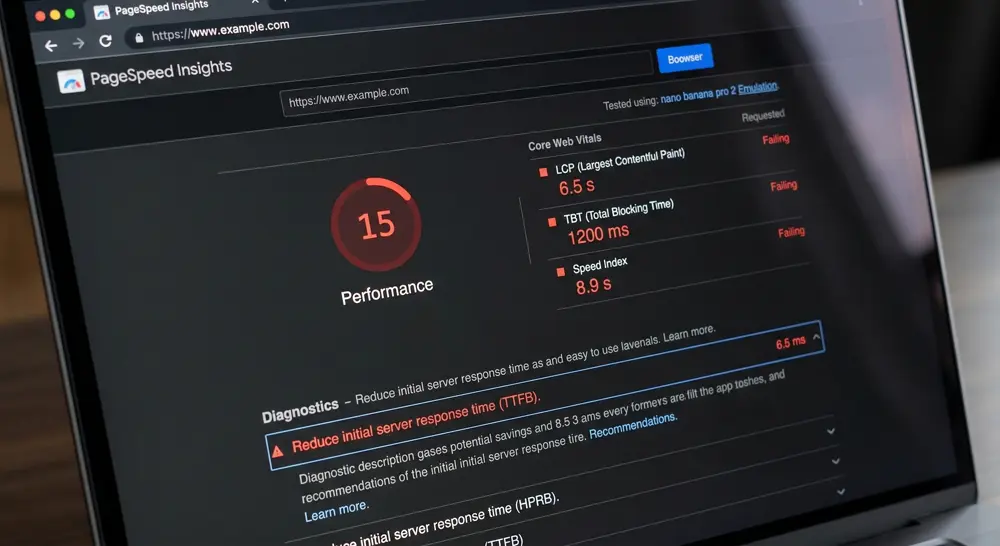
Run a Pagespeed Insights audit on your WordPress site right now. If you are like 90% of Austin-based tech companies, you will see a Performance score somewhere between 25 and 50. Red numbers. Failed Core Web Vitals. A Largest Contentful Paint north of four seconds. Then run the same audit on a competitor who actually invested in a proper WordPress SEO service. The gap is not marginal. It is structural.
In Austin's Silicon Hills, where founders close seed rounds over coffee on South Congress and marketing directors measure everything in sprint cycles, a slow website is not a minor inconvenience. It is a disqualifying signal. If your digital infrastructure cannot keep pace with your ambition, prospects will find someone whose can. In a city that moves faster than a startup pitch on East Sixth, three seconds of load time is an eternity.
The WordPress "Performance Gap": Why Your Pagespeed Score Is Bleeding Revenue
WordPress powers 43% of the internet. This ubiquity is simultaneously its greatest strength and its most dangerous liability. The platform itself is not inherently slow. What makes it slow is everything that gets bolted onto it: 40+ plugins, render-blocking JavaScript from analytics and chat widgets, unoptimized hero images served as 4MB PNGs, and page builders that generate three times the necessary DOM elements.
Here is what a typical Austin tech company's WordPress stack looks like under the hood:
- Elementor or Divi: Injecting 1.2MB+ of CSS and JavaScript on every page load, regardless of whether the page uses those features
- 15 to 25 active plugins: Each adding its own scripts, stylesheets, and database queries. Many conflict with each other.
- Shared hosting: A $12/month server in Virginia adding 80 to 120ms of latency for every Austin visitor
- No image optimization: Hero images served as full-resolution JPEGs when a 90KB WebP would be visually identical
- No caching strategy: Every visit triggers fresh database queries and PHP execution
The result? A Pagespeed Insights score that Google interprets as a direct signal of low quality. Since the Page Experience update, Core Web Vitals are not optional ranking factors. They are baseline requirements. A site scoring 35 on Performance is not competing for page one. It is competing for page three.
Bespoke WordPress vs. Page Builders: The Performance Tax You Did Not Agree To
Let's be direct. If your WordPress site was built with Elementor, Divi, or WPBakery, you are paying a performance tax on every single page load. These tools were designed to make website building accessible to non-developers. They accomplish this by generating massive amounts of redundant HTML, inline CSS, and JavaScript that your browser must parse, compile, and render before anything appears on screen.
The numbers are unambiguous:
- Page builder sites: Average DOM size of 3,000 to 5,000 nodes. LCP of 4.5 to 6.0 seconds. CLS of 0.15 to 0.30.
- Bespoke WordPress: Average DOM size of 800 to 1,200 nodes. LCP of 1.0 to 1.8 seconds. CLS under 0.05.
A bespoke WordPress SEO service eliminates this tax entirely. Every line of code is written with purpose. No unnecessary wrappers. No inline styles generated by a visual editor. No JavaScript loaded for features the page does not use. The result is a WordPress site that performs like a hand-built sports car, not a minivan with a body kit.
For Austin tech brands competing for investor attention, enterprise clients, or talent acquisition, the difference is immediate. A bespoke WordPress site communicates technical competence at the infrastructure level. A page-builder site communicates compromise.
The LTV of Speed: Why Three Seconds Costs You $100K+ Annually
In Austin's tech ecosystem, the lifetime value of a single qualified lead is substantial:
- SaaS companies: Average contract value of $24,000 to $120,000 ARR, with 18 to 36 month retention. LTV: $36,000 to $360,000.
- B2B services: Average engagement of $15,000 to $75,000, with 2.4 repeat engagements per client. LTV: $36,000 to $180,000.
- Funded startups: A single investor relationship facilitated through a credible web presence can yield $500K to $5M in capital.
Google's research shows 53% of mobile users abandon sites that take longer than 3 seconds to load. If your WordPress site's LCP is 4.8 seconds (the average), you are losing more than half your mobile traffic before they see your value proposition. At Austin LTV numbers, that is not a rounding error. It is a six-figure revenue leak, compounding every quarter.
Technical Deep Dive: How We Optimize LCP on WordPress
Largest Contentful Paint (LCP) is the single most impactful Core Web Vital for SEO for WordPress websites. It measures how long it takes for the largest visible element (typically the hero image or headline) to fully render. Google's threshold: under 2.5 seconds is "Good." Over 4.0 seconds is "Poor." Here is how FlashpointWeb engineers sub-1.5-second LCP on WordPress:
- Critical CSS inlining: We extract the CSS needed to render above-the-fold content and inline it directly in the HTML. The browser renders the visible page without waiting for external stylesheet downloads.
- Hero image preloading: The LCP element (usually the hero image) receives a
rel="preload"hint in the document head, telling the browser to fetch it immediately rather than discovering it during DOM parsing. - WebP/AVIF conversion with srcset: Every image is served in next-generation formats at multiple resolutions. A mobile user in a coffee shop on South Lamar receives a 90KB WebP. A designer on a Retina display in the Domain receives a 240KB version. Same visual quality, dramatically different file sizes.
- Plugin audit and elimination: We systematically remove or replace plugins that inject render-blocking resources. A typical audit eliminates 8 to 12 unnecessary plugins, reducing JavaScript payload by 60% to 80%.
- Server-side caching with edge deployment: We implement full-page caching with cache invalidation on content updates, served from CDN edge nodes. An Austin visitor receives the page from a Dallas edge node, not a shared server in Virginia.
- Database query optimization: We eliminate redundant queries from plugins, implement object caching, and optimize custom queries to reduce Time to First Byte (TTFB) to under 200ms.
FlashpointWeb's own Lighthouse audit: 90+ across all categories. Verify via PageSpeed Insights →
WordPress Speed Checklist: The Austin Standard
Use this checklist to audit your WordPress site against the performance benchmarks that determine Austin market visibility:
- ☐ LCP under 2.5s: Hero content fully rendered within Google's "Good" threshold (target: under 1.5s)
- ☐ Total Blocking Time under 200ms: No JavaScript monopolizing the main thread during load
- ☐ CLS under 0.1: Zero layout shift from lazy-loaded images, ads, or web fonts
- ☐ Plugin count under 15: Each plugin audited for render-blocking resources and conflicts
- ☐ Images in WebP/AVIF: All images served in next-gen formats with responsive srcset attributes
- ☐ No page builder overhead: Zero Elementor/Divi/WPBakery CSS or JS loaded on production pages
- ☐ CDN-served assets: All static assets served from edge nodes, not origin server
- ☐ TTFB under 200ms: Server response time optimized with full-page caching and query optimization
EEAT Authority: Why Google Trusts Fast WordPress Sites More
Google's EEAT framework (Experience, Expertise, Authoritativeness, Trust) evaluates your entire digital presence. Technical performance is a direct Trust signal. A WordPress site scoring 90+ on Lighthouse communicates to Google that the organization behind it invests in quality infrastructure. A site scoring 35 communicates the opposite. For Austin's competitive B2B and SaaS landscape, where every company claims to be "innovative" and "cutting-edge," your Pagespeed Insights score is the proof.
Effective SEO for WordPress websites in 2026 requires more than keyword optimization and blog posts. It requires the technical infrastructure to back up your authority claims. Security headers, proper HTTPS enforcement, structured data markup, and sub-2-second load times are the baseline requirements for ranking in competitive verticals. Most WordPress sites fail all four.
The Austin Advantage: Move Now or Pay Later
Here is the strategic reality: the vast majority of Austin tech companies are still running WordPress sites built by generalist agencies using page builders. The competitive moat available to companies that invest in proper WordPress performance engineering is substantial, but it is narrowing. Every quarter, more companies discover that Pagespeed Insights scores directly impact their pipeline. The companies that fix their WordPress infrastructure now will compound that advantage. Those that wait will spend multiples more to catch up.
Your WordPress site is not a brochure. It is your most productive sales asset, working 24/7. The question is whether it is performing at the speed Austin demands.
Request Your WordPress Performance Audit
FlashpointWeb provides specialized WordPress SEO service for Austin tech companies that refuse to accept slow as the default. We will audit your current Pagespeed Insights score, Core Web Vitals, plugin overhead, and hosting performance against your top competitors, complimentary, with no obligation. Schedule your WordPress audit →
Sources
- Google PageSpeed Insights: Core Web Vitals testing and Lighthouse performance scoring
- web.dev: Largest Contentful Paint (LCP): Google's official LCP optimization guide
- web.dev: Web Vitals: Essential metrics for user experience and search ranking
- Google Search Central: Page Experience: How Core Web Vitals affect search rankings
About the Author
James Owen Basuki is the Lead Technical Architect at FlashpointWeb, specializing in WordPress performance engineering, Lighthouse optimization, and Core Web Vitals remediation. He has helped Austin tech companies, SaaS platforms, and B2B firms achieve 90+ Lighthouse scores on WordPress since 2020.
Ready to Build a Lightning-Fast Website?
Get 90+ Lighthouse scores and maximize your conversions with our modern web solutions.
Contact Us TodayRelated Articles
Why is My WordPress Website So Slow?
The real answer from an expert who has migrated dozens of enterprise sites. Learn why your WordPress site keeps dragging your business down and what actually works to fix it.

Why Your Seattle Website Is Losing Customers in 3 Seconds (and How Speed Drives Retention)
If your website takes more than 3 seconds to load, you are losing over half your visitors before they see what you offer. Here is why speed is the most important investment a Seattle business can make, explained simply.