Why Your Seattle Website Is Losing Customers in 3 Seconds (and How Speed Drives Retention)


Imagine walking into a store in Pioneer Square. You open the door, step inside, and... nothing. The lights don't turn on for three seconds. The shelves are empty for five. By the time the products appear, you have already turned around and walked to the shop next door. That is exactly what happens when your website is slow. Except online, your customer doesn't just walk next door. They walk to your competitor's site, and Google helped them get there.
In Seattle's Pacific Northwest tech corridor, where Amazon, Microsoft, and Expedia have trained every consumer to expect instant digital experiences, a slow website is more than an inconvenience. It is a competitive disqualifier. Your customers are used to pages that load in under a second. When yours takes five, they don't wait. They leave. And they don't come back.
This guide is going to explain, in simple terms, exactly why your site is slow, what makes a website fast, and how the right technology turns your website from a liability into your most productive sales tool. No jargon. No code speak. Just the information you need to make a smart decision for your business.
WordPress vs. Astro: The SUV vs. EV of Websites
Most business websites run on WordPress. WordPress is powerful, flexible, and familiar. But here is something most web agencies will not tell you: WordPress was built in 2003 to power blogs, and under the hood, it still works like one. Every time a visitor clicks on your site, WordPress has to build the entire page from scratch. It calls a database, assembles the layout, loads 20+ plugins, and then finally shows the result to your visitor. Every. Single. Time.
Think of it like an SUV. It can do everything: tow a boat, drive off-road, carry seven passengers. But it burns a lot of fuel doing it, even when you are just driving to get coffee. Most business websites don't need an SUV. They need something built for efficiency.
That is where Astro comes in. Astro is a modern framework that builds your entire website in advance. When a visitor arrives, the page is already built and waiting for them, like an electric vehicle that is fully charged and ready to go. No database calls. No plugin overhead. No waiting. The result is a site that loads in under one second instead of four to six.
| Factor | WordPress (The SUV) | Astro (The EV) |
|---|---|---|
| How it works | Builds every page on demand, every visit | Pages are pre-built, ready to serve instantly |
| Typical load time | 3 to 6 seconds | 0.5 to 1.5 seconds |
| Lighthouse score | 25 to 55 (typical) | 90+ across all categories |
| Plugin overhead | 20 to 40 plugins, each adding weight | Zero unnecessary code shipped |
| Security risk | High (plugins need constant updates) | Minimal (no database to attack) |
| Maintenance | Weekly plugin and core updates | Near zero once deployed |
| Best for | Complex apps, frequent content changes | Business sites, marketing, portfolios |
This is not about WordPress being "bad." It is about using the right tool for the job. If you are a Seattle business that needs a fast, reliable website that ranks well and converts visitors into customers, Astro is purpose-built for exactly that.
The Hosting Secret: Why "Where" Your Site Lives Matters as Much as "How" It's Built
Most websites are hosted on a single server in a data center somewhere. Maybe it is in Virginia. Maybe Ohio. When a customer in Ballard visits your site, their request travels across the country to that server, the server builds the page, and then sends it all the way back to Seattle. That round trip adds precious seconds.
Cloudflare's Edge Network works differently. Instead of one server, your website is copied to over 300 locations worldwide. When a customer in Fremont visits your site, they receive it from a server right here in Seattle. When a customer in Portland visits, they get it from Portland. Tokyo? Tokyo. The content is already there, waiting, at the nearest location. No cross-country round trip. No waiting.
Combined with Astro's pre-built pages, this is the difference between your customer waiting 4 seconds and your customer seeing your site in under 1 second. To put it simply: your website becomes as fast as the WiFi your customer is on.
Why Speed Directly Impacts Your Revenue (The LTV Connection)
Here is where this gets real. Website speed is not a "nice to have." It directly impacts how much money your business makes. There are two reasons:
1. Google Ranks Fast Sites Higher
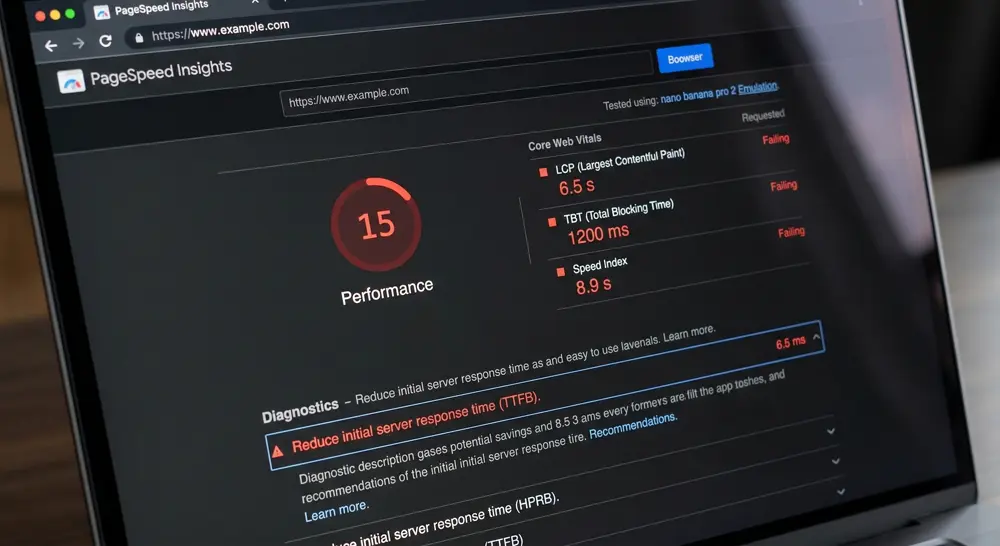
Google has stated publicly that site speed is a ranking factor. They measure it through something called Pagespeed Insights, which scores your site on Performance, Accessibility, Best Practices, and SEO. If your site scores below 50 (and most WordPress sites do), Google is actively pushing you down in search results. Your competitor with a faster site appears first. They get the click. They get the customer. You get page two.
2. Fast Sites Keep Customers Longer
Google's own research shows that 53% of mobile visitors leave a site that takes more than 3 seconds to load. But the inverse is equally powerful: a fast site keeps visitors engaged. They browse more pages. They spend more time reading about your services. They are more likely to fill out a contact form or make a purchase. Over time, this compounds into what marketers call Customer Lifetime Value (LTV): the total revenue a single customer generates throughout their relationship with your business.
Consider a Seattle-based professional services firm. A single client retained through a strong web experience might generate $20,000 to $100,000 over the relationship. If a fast, well-designed website captures just two additional clients per month that a slow site would have lost, the math becomes impossible to ignore. Speed is not a technical metric. It is a revenue multiplier.
The 90+ Lighthouse Goal: What It Means and Why It Matters
Pagespeed Insights gives your site a score from 0 to 100 across four categories. At FlashpointWeb, we engineer every site to score 90 or above in all four: Performance, Accessibility, Best Practices, and SEO. This is the "green zone," the score that tells Google your site is technically excellent and deserves to rank well.
Achieving 90+ on a standard WordPress setup is, for all practical purposes, nearly impossible. The plugin overhead, database queries, and render-blocking JavaScript create a performance ceiling that no amount of caching plugins can overcome. It is like trying to get a delivery truck to win a Formula 1 race by putting racing stripes on it.
Astro and Cloudflare together remove that ceiling entirely. The site ships zero unnecessary code, loads in under a second, and is served from the nearest edge location. The 90+ score is not a stretch goal. It is the baseline.
FlashpointWeb's own Lighthouse audit: 90+ across all categories. Verify via PageSpeed Insights →
What This Means for Your Seattle Business
Seattle is one of the most digitally sophisticated markets in the country. Your customers interact with world-class digital experiences every day, from Amazon's one-click ordering to Expedia's instant search results. They expect the same speed and polish from every business they encounter online, including yours. A responsive design that loads instantly on every device, from a desktop in a Capitol Hill office to a phone on the Link Light Rail, is not a luxury. It is baseline.
If your current website takes more than 3 seconds to load, here is the simple truth: you are losing customers every single day. Not because your product or service is not excellent. Not because your team is not talented. Because your website is not fast enough to give those customers the chance to discover what you offer.
Your website should be your hardest-working team member, available 24/7, making a great first impression in under one second. If it is not doing that today, the fix is simpler than you think.
Request Your Performance Migration Audit
FlashpointWeb specializes in transforming slow websites into fast, high-performing digital assets. We will audit your current Pagespeed Insights score, identify exactly what is slowing you down, and show you what a 90+ Lighthouse score looks like for your business, complimentary, with no obligation. Schedule your performance audit →
Sources
- Google PageSpeed Insights: Core Web Vitals testing and performance scoring
- web.dev: Web Vitals: Essential metrics for user experience and search ranking
- web.dev: Largest Contentful Paint (LCP): Google's official LCP optimization guide
- Google Search Central: Page Experience: How Core Web Vitals affect search rankings
About the Author
James Owen Basuki is the Lead Cloud Architect at FlashpointWeb, specializing in high-performance web infrastructure built on Astro and deployed to Cloudflare's edge network. He helps Seattle businesses, professional services firms, and tech companies achieve 90+ Lighthouse scores and convert more visitors into customers.
Ready to Build a Lightning-Fast Website?
Get 90+ Lighthouse scores and maximize your conversions with our modern web solutions.
Contact Us TodayRelated Articles
Why is My WordPress Website So Slow?
The real answer from an expert who has migrated dozens of enterprise sites. Learn why your WordPress site keeps dragging your business down and what actually works to fix it.

WordPress SEO Service: Why 90% of Austin's Tech Brands Are Failing Pagespeed Insights
Austin moves fast. Your WordPress site doesn't. Here's why the Silicon Hills elite are ditching page builders, investing in bespoke WordPress development, and turning Pagespeed Insights scores into a competitive weapon.